Wednesday, May 30, 2018

Top 5 Canadian Stocks To Invest In 2019

tags:WFC,NRG,COP,THO,NG,

Canadian home sales fell to the lowest in more than five years in April, as tougher mortgage qualification rules deterred buyers.

The number of homes sold last month declined 2.9 percent from March, the Canadian Real Estate Association said Tuesday from Ottawa. Declines were recorded in about 60 percent of cities tracked including Vancouver, Calgary, Toronto and Montreal.

It was a disappointing start to the busy spring selling season for realtors that suggests markets are still struggling with tougher rules that require borrowers to prove they can afford to cope with higher interest rates. Policy makers made the changes along with other steps, such as foreign buyers taxes, to put the brakes on a surge in price gains last year that some fear could be a danger to the financial system.

The drop in April is the third monthly decline this year, with sales down over 20 percent since December. The new mortgage qualification rules kicked on Jan. 1.

Top 5 Canadian Stocks To Invest In 2019: Wells Fargo & Company(WFC)

Advisors' Opinion:
  • [By Motley Fool Staff]

    Wells Fargo and Company (NYSE:WFC)Q1 2018 Earnings Conference CallApril 13, 2018, 10:00 a.m. ET

    Contents: Prepared Remarks Questions and Answers Call Participants Prepared Remarks:

    Operator

  • [By Chris Lange]

    Wells Fargo & Co. (NYSE: WFC) short interest shrank to 31.68 million shares from the previous reading of 35.77 million. Shares were trading at $52.10, within a 52-week range of $49.27 to $66.31.

  • [By Lee Jackson]

    Though this large cap bank is a solid value play for 2018, it still faces the possibility of large fines.�Wells Fargo & Co. (NYSE: WFC) is a�nationwide, diversified, community-based financial services company with $1.8 trillion in assets. The company provides banking, insurance, investments, mortgage and consumer and commercial finance through 8,700 locations, 12,800 ATMs, the Internet and mobile banking. It also has offices in 36 countries to support customers who conduct business in the global economy. Wells Fargo serves one in three households in the United States.

  • [By Garrett Baldwin]

    Earnings season will kick into high gear today with the release of multiple reports from three of the nation's top financial institutions. JPMorgan Chase & Co. (NYSE: JPM), Wells Fargo & Co.�(NYSE: WFC), and Citigroup Inc. (NYSE: C) will all be in the spotlight today. U.S. President Donald Trump could be shaking up trade policy. However, it isn't NAFTA or tariffs with China that are headlining the story. According to reports, Trump has requested his advisors explore American reentry into the Transpacific Partnership (TPP). President Trump pulled the United States out of TPP shortly following his inauguration. The recommendation comes after lawmakers from ag-producing states discussed the impact of leaving the deal with the administration. The decision to reenter the TPP would be very valuable to states that produce the bulk of U.S. wheat given that it would allow exporters to avoid tariffs of $65 per tonne to Japan, which is the largest export market for American wheat. Leading nations of the pact, such as Japan and Australia, reacted coolly to the president's pivot but did not rule out the possibility of American reentry. Facebook Inc. (Nasdaq: FB) is still in focus across the financial world. Facebook CEO Mark Zuckerberg appeared before Congress two times this week to address his firm's ongoing data scandal involving consulting firm Cambridge Analytica. Congress' failure to understand how the Internet works and Facebook's business model was on full display, but Zuckerberg was able to maintain his composure as he answered questions over the two-day period. Stocks to Watch Today: JPM, WFC, C Shares of JPMorgan Chase & Co. (NYSE: JPM) are in focus as the bank prepares to report Q1 earnings before the bell. JPM stock added 1.1% despite falling short of profit expectations. Wall Street anticipated that the firm would report earnings per share (EPS) of $2.28 on top of $27.53 billion in revenue. The firm reported EPS of $2.26; however, it reported
  • [By Ethan Ryder]

    Shares of Wells Fargo (NYSE:WFC) have received a consensus rating of “Hold” from the twenty-nine research firms that are currently covering the firm, Marketbeat.com reports. Six investment analysts have rated the stock with a sell recommendation, seven have given a hold recommendation and sixteen have given a buy recommendation to the company. The average 12 month target price among brokers that have issued ratings on the stock in the last year is $61.86.

  • [By Matthew Frankel]

    It's been an eventful week in the financial markets. Wells Fargo's (NYSE:WFC) scandals are in the headlines (again), the two largest investment banks reported excellent earnings, and there's another data breach consumers should know about.

Top 5 Canadian Stocks To Invest In 2019: NRG Energy Inc.(NRG)

Advisors' Opinion:
  • [By Ethan Ryder]

    DTE Energy (NYSE: DTE) and NRG Energy (NYSE:NRG) are both utilities companies, but which is the superior investment? We will contrast the two businesses based on the strength of their earnings, institutional ownership, profitability, valuation, risk, dividends and analyst recommendations.

  • [By Jon C. Ogg]

    NRG Energy Inc. (NYSE: NRG) was started with a Buy rating and�assigned a $37 price objective (versus a $33.15 close) at Merrill Lynch.

    Oasis Petroleum Corp. (NYSE: OAS) was reiterated as Overweight and the target price was raised to $17 from $13 at Morgan Stanley.

Top 5 Canadian Stocks To Invest In 2019: ConocoPhillips(COP)

Advisors' Opinion:
  • [By Matthew DiLallo]

    Oil prices have been on fire over the past year and recently topped $70 a barrel, which is the highest crude has been since late 2014. That rally in the oil market has helped fuel big-time gains in many oil stocks. Three that stand out are Anadarko Petroleum (NYSE:APC), Hess (NYSE:HES), and ConocoPhillips (NYSE:COP) because each has risen more than 20% this year. They might still have additional upside from here given that all three plan on spending billions of dollars to buy back more of their stock.

  • [By Matthew DiLallo]

    Shares of ConocoPhillips (NYSE:COP) continued rallying last month, rising another 10%, which put them up more than 40% over the past year. Fueling April's surge -- which added more than $7.5 billion to the company's market cap -- was a combination of higher oil prices, another oil discovery in Alaska, and strong first-quarter results.

  • [By Matthew DiLallo]

    ConocoPhillips (NYSE:COP) has worked hard to differentiate itself from other oil companies by focusing on creating value for investors as opposed to growing at all costs. That plan continued paying dividends during the first quarter, as the company blew past expectations. That strong showing sets the U.S. oil giant up for an exceptional year.

Top 5 Canadian Stocks To Invest In 2019: Thor Industries Inc.(THO)

Advisors' Opinion:
  • [By ]

    Thor Industries (THO) : "They had expenses and inventory go up and it's been hurt by both. Those are negatives."

    Hain Celestial Group (HAIN) : "They had a bad quarter with bad guidance. I can't reassure you here. "

  • [By Logan Wallace]

    Tahoe Resources (TSE:THO) (NASDAQ:TAHO) – Equities research analysts at National Bank Financial reduced their FY2018 earnings estimates for shares of Tahoe Resources in a research report issued on Monday, April 9th. National Bank Financial analyst M. Parkin now forecasts that the company will earn $0.29 per share for the year, down from their prior forecast of $0.35. National Bank Financial currently has a “Sector Perform” rating and a $8.00 price objective on the stock.

  • [By ]

    Cramer was bearish on Thor Industries (THO) and Hain Celestial Group (HAIN) .

    Search Jim Cramer's "Mad Money" trading recommendations using our exclusive "Mad Money" Stock Screener.

Top 5 Canadian Stocks To Invest In 2019: Natural Gas(NG)

Advisors' Opinion:
  • [By Money Morning Staff Reports]

    Canadian gold mining company NovaGold Resources Inc. (NYSE: NG) shows an even starker change in sentiment. In the last 12 months, the volume of short bets on the stock declined 79%, to 522,400.

  • [By Money Morning News Team]

    Canadian gold mining company NovaGold Resources Inc. (NYSE: NG) shows an even starker change in sentiment. In the last six months, the volume of short bets on the stock declined 32.75%, from 19.05 million shares to 12.81 million.

  • [By Shane Hupp]

    JPMorgan Chase set a GBX 870 ($11.80) target price on National Grid (LON:NG) in a research note released on Monday. The brokerage currently has a buy rating on the stock.

Monday, May 28, 2018

Hot Safest Stocks To Watch For 2018

tags:MIC,OII,DRAD,MKSI,

Shutterstock

We spend most of our working lives contributing money to retirement accounts but what about taking it out in retirement? If you have pre-tax, Roth, and taxable accounts, how much should you withdraw from each one? Here are some things to consider:

1) How much can you safely withdraw? The safest option is to only withdraw earnings and not touch any of the principal but at current dividend yields and interest rates, don't expect to get much more than about 2% of your portfolio. That's probably not enough for most people and that number can fluctuate and may not keep pace with inflation in the long term.

The traditional rule of thumb is that you can safely withdraw about 4% of the initial value of a diversified portfolio and increase that amount with inflation for about 30 years. However, the rule was developed during the 1990s when interest rates were higher and many financial experts (including the financial planner who created it) are concerned that the rule is now obsolete. It also doesn't take into account that you may have to withdraw larger amounts while you still have a mortgage or before you start collecting pension and Social Security benefits so a steady withdrawal rate may not make sense.

Hot Safest Stocks To Watch For 2018: Macquarie Infrastructure Company(MIC)

Advisors' Opinion:
  • [By Stephan Byrd]

    Sunoco (NYSE: SUN) and Macquarie Infrastructure (NYSE:MIC) are both mid-cap oils/energy companies, but which is the better investment? We will compare the two businesses based on the strength of their earnings, risk, profitability, dividends, analyst recommendations, valuation and institutional ownership.

  • [By Max Byerly]

    Genworth MI Canada Inc. (TSE:MIC) has earned a consensus rating of “Hold” from the six brokerages that are covering the company, MarketBeat.com reports. Four analysts have rated the stock with a hold recommendation and two have issued a buy recommendation on the company. The average 12 month price objective among analysts that have issued a report on the stock in the last year is C$47.33.

  • [By Ethan Ryder]

    These are some of the headlines that may have impacted Accern Sentiment’s scoring:

    Get Macquarie Infrastructure alerts: EQUITY ALERT: Levi & Korsinsky, LLP Reminds Shareholders of Macquarie Infrastructure Corporation of a Class Action Lawsuit and a Lead Plaintiff Deadline of June 25, 2018 �� MIC (finance.yahoo.com) Macquarie Infrastructure (MIC) Director Acquires $7,136,892.00 in Stock (americanbankingnews.com) Rohatyn Group acquires JP Morgan’s Asia infrastructure portfolio (dealstreetasia.com) Form 8-K Macquarie Infrastructure For: May 16 (streetinsider.com) Macquarie Infrastructure Partners amasses over $3.84 bln for fourth fund (pehub.com)

    Several brokerages have recently commented on MIC. Zacks Investment Research raised Macquarie Infrastructure from a “sell” rating to a “hold” rating in a research note on Tuesday, January 30th. ValuEngine lowered Macquarie Infrastructure from a “hold” rating to a “sell” rating in a research note on Thursday, March 1st. Royal Bank of Canada decreased their price target on Macquarie Infrastructure to $55.00 and set an “outperform” rating on the stock in a research note on Friday, February 23rd. JPMorgan Chase & Co. lowered Macquarie Infrastructure from an “overweight” rating to a “neutral” rating in a research note on Thursday, February 22nd. Finally, SunTrust Banks lowered Macquarie Infrastructure from a “buy” rating to a “hold” rating in a research note on Thursday, February 22nd. Three investment analysts have rated the stock with a sell rating, five have given a hold rating and two have given a buy rating to the company. The stock has an average rating of “Hold” and an average price target of $57.00.

  • [By Paul Ausick]

    Macquarie Infrastructure Corp. (NYSE: MIC) fell nearly 42% Thursday to post a new 52-week low of $37.06 after closing at $63.62 on Wednesday. The 52-week high is $81.74. Volume of about 24 million was nearly 30 times the daily average. The company chopped its dividend by about 28% to $4 a year. There’s no better way to make investors flee.

  • [By Joseph Griffin]

    Atria Investments LLC raised its holdings in Macquarie Infrastructure (NYSE:MIC) by 59.3% in the first quarter, according to the company in its most recent disclosure with the SEC. The firm owned 8,737 shares of the conglomerate’s stock after acquiring an additional 3,251 shares during the quarter. Atria Investments LLC’s holdings in Macquarie Infrastructure were worth $323,000 as of its most recent filing with the SEC.

Hot Safest Stocks To Watch For 2018: Oceaneering International, Inc.(OII)

Advisors' Opinion:
  • [By Logan Wallace]

    Cypress Energy Partners (NYSE: CELP) and Oceaneering International (NYSE:OII) are both oils/energy companies, but which is the superior business? We will contrast the two companies based on the strength of their dividends, analyst recommendations, risk, valuation, institutional ownership, earnings and profitability.

  • [By Matthew DiLallo]

    Oceaneering International (NYSE:OII) warned investors earlier this year that 2018 would be a challenging one. The offshore service and product company also thought that the first quarter would be particularly tough because it's a seasonally weaker quarter. While it�didn't go exactly as the company envisioned, the results met its muted expectations overall.

  • [By Ethan Ryder]

    Get a free copy of the Zacks research report on Oceaneering International (OII)

    For more information about research offerings from Zacks Investment Research, visit Zacks.com

  • [By Todd Campbell]

    I've�written previously�about my belief that shrinking oil inventories and rising crude oil prices will spark a recovery in energy services stocks, and I've already explained why Core Labs�and Hess Corp are favorite stocks of mine to buy. Now, after reviewing�Oceaneering International's (NYSE:OII) first-quarter results,�I'm increasingly convinced that it's a great time to add this stock to any portfolio.

Hot Safest Stocks To Watch For 2018: Digirad Corporation(DRAD)

Advisors' Opinion:
  • [By ]

    Some of these are even smaller nano-caps, such as medical device maker Digirad (Nasdaq: DRAD), whose entire market value is just $36 million.

    There is absolutely nothing wrong with small businesses. I own shares of quite a few in my personal account. But for the most part, I use them to fill out the growth sleeve of my portfolio and don't consider them stable income producers.

Hot Safest Stocks To Watch For 2018: MKS Instruments, Inc.(MKSI)

Advisors' Opinion:
  • [By Stephan Byrd]

    MKS Instruments, Inc. (NASDAQ:MKSI) Director Richard S. Chute sold 1,988 shares of the firm’s stock in a transaction that occurred on Wednesday, May 9th. The shares were sold at an average price of $110.75, for a total value of $220,171.00. Following the completion of the sale, the director now directly owns 10,103 shares of the company’s stock, valued at $1,118,907.25. The transaction was disclosed in a document filed with the SEC, which is available through this hyperlink.

  • [By Logan Wallace]

    MKS Instruments, Inc. (NASDAQ:MKSI) Director Peter Hanley sold 250 shares of the business’s stock in a transaction dated Friday, May 11th. The shares were sold at an average price of $113.70, for a total transaction of $28,425.00. Following the completion of the transaction, the director now owns 3,241 shares in the company, valued at $368,501.70. The transaction was disclosed in a legal filing with the Securities & Exchange Commission, which can be accessed through this hyperlink.

Sunday, May 27, 2018

World Acceptance Corp. (WRLD) Expected to Post Quarterly Sales of $132.30 Million

Wall Street brokerages forecast that World Acceptance Corp. (NASDAQ:WRLD) will post sales of $132.30 million for the current quarter, according to Zacks Investment Research. Two analysts have issued estimates for World Acceptance’s earnings. The highest sales estimate is $132.87 million and the lowest is $131.73 million. World Acceptance posted sales of $128.91 million in the same quarter last year, which would indicate a positive year-over-year growth rate of 2.6%. The firm is scheduled to announce its next earnings results on Thursday, August 2nd.

According to Zacks, analysts expect that World Acceptance will report full year sales of $567.95 million for the current financial year, with estimates ranging from $565.02 million to $570.87 million. For the next fiscal year, analysts anticipate that the company will post sales of $588.04 million per share. Zacks’ sales calculations are a mean average based on a survey of research analysts that cover World Acceptance.

Get World Acceptance alerts:

World Acceptance (NASDAQ:WRLD) last announced its quarterly earnings data on Thursday, May 10th. The credit services provider reported $3.70 EPS for the quarter, missing analysts’ consensus estimates of $3.94 by ($0.24). World Acceptance had a return on equity of 13.82% and a net margin of 9.78%. The company had revenue of $151.86 million for the quarter, compared to analyst estimates of $147.04 million. During the same period last year, the firm earned $3.64 earnings per share. The firm’s revenue for the quarter was up 5.0% on a year-over-year basis.

A number of research analysts have issued reports on WRLD shares. TheStreet raised World Acceptance from a “c” rating to a “b-” rating in a research note on Thursday, May 10th. Zacks Investment Research raised World Acceptance from a “hold” rating to a “buy” rating and set a $126.00 target price for the company in a research note on Saturday, February 3rd. BidaskClub raised World Acceptance from a “hold” rating to a “buy” rating in a research note on Wednesday, January 31st. ValuEngine cut World Acceptance from a “strong-buy” rating to a “buy” rating in a research note on Wednesday, May 2nd. Finally, BMO Capital Markets reissued a “sell” rating and issued a $80.00 target price on shares of World Acceptance in a research note on Monday, January 29th. They noted that the move was a valuation call. Three research analysts have rated the stock with a sell rating, two have issued a hold rating and one has issued a buy rating to the company. World Acceptance has an average rating of “Hold” and an average price target of $84.50.

Shares of World Acceptance traded up $0.35, reaching $107.87, during trading on Thursday, Marketbeat.com reports. 33,165 shares of the company were exchanged, compared to its average volume of 78,365. World Acceptance has a twelve month low of $71.02 and a twelve month high of $121.17. The company has a quick ratio of 20.24, a current ratio of 13.78 and a debt-to-equity ratio of 0.45. The stock has a market cap of $979.59 million, a PE ratio of 14.08 and a beta of 2.72.

A number of large investors have recently bought and sold shares of the business. Principal Financial Group Inc. grew its stake in World Acceptance by 4.8% in the first quarter. Principal Financial Group Inc. now owns 46,784 shares of the credit services provider’s stock valued at $4,926,000 after acquiring an additional 2,159 shares during the period. WINTON GROUP Ltd acquired a new position in World Acceptance in the first quarter valued at about $5,827,000. Legal & General Group Plc boosted its position in shares of World Acceptance by 5.0% during the first quarter. Legal & General Group Plc now owns 11,336 shares of the credit services provider’s stock worth $1,182,000 after buying an additional 544 shares during the period. Element Capital Management LLC acquired a new position in shares of World Acceptance during the first quarter worth about $521,000. Finally, Barclays PLC boosted its position in shares of World Acceptance by 26.8% during the first quarter. Barclays PLC now owns 6,833 shares of the credit services provider’s stock worth $720,000 after buying an additional 1,443 shares during the period. 93.06% of the stock is owned by hedge funds and other institutional investors.

About World Acceptance

World Acceptance Corporation engages in small-loan consumer finance business. The company offers short-term small and medium-term larger installment loans, as well as related credit insurance and ancillary products and services to individuals. It also provides automobile club memberships to its borrowers; and income tax return preparation and electronic filing services.

Get a free copy of the Zacks research report on World Acceptance (WRLD)

For more information about research offerings from Zacks Investment Research, visit Zacks.com

Earnings History and Estimates for World Acceptance (NASDAQ:WRLD)

Saturday, May 26, 2018

Leverage Alert Ringing While Cash Drains From Stock Broker Accounts

Few things evoke fear in markets like a margin call. Now there are signs that many U.S. stock investors are ill-prepared to deal with one.

The issue is net cash in equity brokerage accounts, seen by some as a proxy for how well-cushioned traders are from forced liquidations if stocks start to plummet. It’s calculated by subtracting the amount of debt used to buy securities from money in an account that’s available to buy more.

And right now, it’s perilously low.

#lazy-img-328040338:before{padding-top:56.25%;}

The deficit just reached $317 billion, the widest ever, according to New York Stock Exchange data compiled by Sundial Capital Research Inc. The previous record was set in January, right before the S&P 500 Index suffered its first 10 percent correction in two years.

Cash “seems to provide less of a cushion for any decline in the value of stock,” Jason Goepfert, president of Sundial Capital Research Inc., wrote in a note to clients. “That is clearly concerning.”

There are few topics in the market subject as much demagoguery as margin debt, and a standard critique over the the period of the bull market has been that it’s at untenable levels -- $652 billion, by the NYSE’s last count. What’s usually lost in the discussion is that such debt basically always rises with the value of equities -- the two are virtually synonymous since one collateralizes by the other.

What’s bad is when the expansion of margin comes untethered from the slope of equities, signaling people are taking out loans even faster than stocks are appreciating. That happened in the final year of the last two bull markets, when margin loan growth outpaced share gains by twofold in 2007 and almost four times in 2000.

Nothing like that is happening now. At the same time, a similarly dire picture is evident when cash credits in brokerage accounts are taken into consideration. Available for investors to withdraw at any time, for any purpose, they include proceeds from short sales and extra buying power held in margin accounts. Last month, they fell 3.3 percent to $335 billion, the lowest level in four years.

Think of the money as assets on a balance sheet and stock loans as liabilities. As traders withdrew cash while at the same time raising debt, their financial health, or in Sundial’s term “net wealth,” deteriorates.

“Debt alone doesn’t tell the whole story,” Goepfert said. “The new record in negative net worth is most concerning, just not as concerning as it would be if the growth in debt was more extreme. The latest drop in net worth is due more to a drain of cash out of accounts as opposed to an increase in debt. Maybe that’s just as worrisome.”

LISTEN TO ARTICLE 2:33 Share Share on Facebook Post to Twitter Send as an Email Print

Friday, May 25, 2018

South Korea ETF falls as Trump cancels summit with North Korea

The largest exchange-traded fund to track South Korea's equity market fell on Thursday, after President Donald Trump called off a planned summit meeting with leader Kim Jong Un of North Korea, adding a new element of geopolitical uncertainty into the region. The iShares MSCI South Korea ETF EWY, -1.65% lost 1.1%, having previously traded down around 0.3% on the day. The Dow Jones Industrial Average DJIA, -0.47% fell 0.6% while the S&P 500 SPX, -0.43% lost 0.5% and the Nasdaq Composite Index COMP, -0.32% fell 0.5%.

Thursday, May 24, 2018

Ford: America's Dumbest Company?

Over the last few weeks we had people calling Ford (F) 'America's dumbest' company. The reasons range from the decision to focus on trucks to the death of the US consumer. I am sticking to my call that dividends will outperform capital gains but I have to refute the 'total breakdown' thesis.

Source: Ford

America's Dumbest Company

Before I go any further, I have to mention a very important point. In April of this year, I wrote an article which mentioned an interesting mid-term opportunity. Even though my article started on a negative note I am not revising that call as I will further explain in this article.

A recent article compared the current economic environment to the one in 2005-2006. Car manufacturers shifted to trucks and SUV right before the economic crisis of 2008 given the higher demand of trucks. Since 2015/2016 we are seeing the same trend once again. Ford among others have presented investors with lower car sales and ripping truck/SUV sales almost every single month. Especially 2017 saw strong gains in the SUV and truck market.

That being said, Ford is now cutting low margin models like the Fiesta, Taurus and Fusion as I cited below.

Ford said on Wednesday the only passenger car models it plans to keep on the market in North America will be the Mustang and the upcoming Ford Focus Active, a crossover-like hatchback that's slated to debut in 2019.

That means the Fiesta, Taurus, Fusion and the regular Focus will disappear in the United States and Canada.

Ford will, however, continue to offer its full gamut of trucks, SUVs and crossovers.

- Dollar Collapse

The conclusion of the article was: ''Detroit may have handed short sellers yet another sure thing.''

The first thing I have to mention is that I am not cherry picking by referring to a website that reveals its bias in its very name. The news of Ford focusing on trucks and SUVs has been all over the internet so to speak.

Overall, I do not disagree that the current trend of rising inflation is extremely bad for the US consumer on the long run. Oil and gas prices are ripping while other key inflation indicators like housing related expenses keep their pace.

However, the reason why Ford's decision to focus on bigger vehicles is not the end of the world is because the company continues to produce the smaller vehicles in Europe for example. The technologies are ready once Ford sees the need to satisfy a rising demand of smaller vehicles. This aspect of the story is almost always ignored when people discuss Ford's decisions.

It's The Bigger Trend That Counts

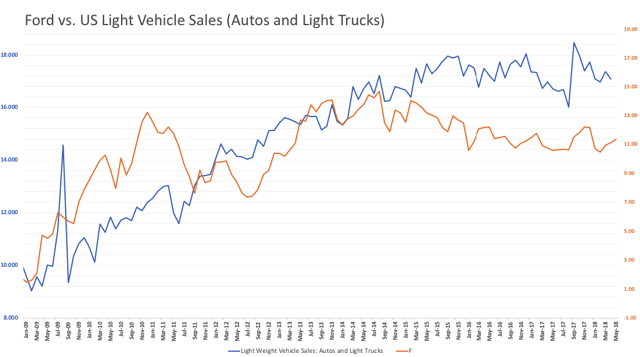
The reason why Ford is not going anywhere is the auto sales peak. And by 'not going anywhere' I mean making bigger moves like the stock did in 2011 and 2012 when the US consumer celebrated its comeback.

Car sales never really made it past 18 million units per year. Sales went up from slightly less than 9 million during the GFC to 18 million in 2017.

Note that Ford peaked during the same time when sales lost their momentum. Prior to that, the company rewarded its investors with triple digit stock price returns.

Source: Author's Spreadsheets (Raw Data: FRED)

Just last month, Ford reported a total sales decline of 4.7% which was once again led by a 15% decline among cars while trucks almost added another 1%. Especially the F-150 saw a higher ticket price which was up $900 on a month-on-month basis while F-150 sales growth has been positive for 12 consecutive month.

Source: Ford Sales Report April 2018

All of this is clear evidence of an ongoing trend from cars to trucks. Numbers like these are unlikely to occur during a recession.

That being said, it's simply not enough to turn the trend around. Investors are looking for opportunities for companies to growth their market share/sales. The current environment is simply not offering these opportunities.

What's Next?

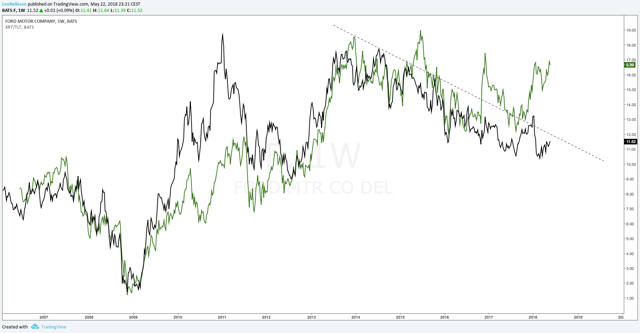
Despite the fact that expectations are low regarding Ford's sales in the US, we see favorable momentum in the retail industry. The ratio spread between retail stocks (XRT) and long term government bonds (TLT) as displayed by the green line has gained strength over the past few weeks. Normally, this is a positive sign for Ford given that this index displays investor's expectations when it comes to the US consumer.

I am still sticking to my call that Ford is likely going to hit $12.50 on the mid-term. This move is fueled by above-average economic sentiment and returning strength in the US retail industry.

Source: TradingView

However, I am also sticking to my call that the long term is looking less favorable. No, Ford is not going bankrupt and it is also not missing any technological trends. Even the focus on trucks is not going to end this company's long history.

The simple problem is that car sales have peaked. And it is extremely unlikely that late-cycle growth is going to push these numbers higher. If you are long Ford as a dividend investor I advise to stay long. Enjoy your dividend but make sure that your exposure is not too large given the cyclical nature of this company. Mid-term traders (like me) should stick to the company and start selling around $12.5 as this is a point which might see increasing resistance.

Stay tuned!

Thank you for reading my article. Please let me know what you think of my thesis. Your input is highly appreciated!

Disclosure: I am/we are long F.

I wrote this article myself, and it expresses my own opinions. I am not receiving compensation for it (other than from Seeking Alpha). I have no business relationship with any company whose stock is mentioned in this article.

Additional disclosure: This article serves the sole purpose of adding value to the research process. Always take care of your own risk management and asset allocation.

Wednesday, May 23, 2018

The Bond Market Needs A Margin Of Safety, Too

&l;p&g;&l;img class=&q;dam-image shutterstock size-large wp-image-784748005&q; src=&q;https://specials-images.forbesimg.com/dam/imageserve/784748005/960x0.jpg?fit=scale&q; data-height=&q;640&q; data-width=&q;960&q;&g; Shutterstock

&l;span&g;Warren Buffett popularized Ben Graham&s;s&a;nbsp;notion of &q;Margin of Safety&q; when evaluating the quality of an investment. The idea is that the future is unpredictable and we have to allow for the&a;nbsp;chance that our projections may be wrong, so we need a cushion in our analysis to protect us when things don&s;t go according to plan. A business with high operating margins, for example, could be said to have a&a;nbsp;large margin of safety; a minor mistake in estimating costs or a temporary drop in sales won&s;t cause the business to swing from a profit to a loss. We can apply the same concept to the bond market.&l;/span&g;

&l;span&g;There is a margin of safety in short-dated investment grade bonds. By short-dated investment grade, I mean Treasuries, Agency mortgage-backed securities and high-quality corporate bonds with 1-3 years left until maturity. The default risk is low and the interest rate risk, or bond price volatility, is small due to the low duration. That said, 2018 is shaping up to be the worst year for this category of bonds in the last 25 years.&l;/span&g;

&l;span&g;Year to date, the return on Bloomberg Barclays Aggregate Index is -2.8%, the worst since 1994 and only one of four down years in the last quarter century. The total return for the 1-3 year subcomponent of the index is also negative so far in 2018. Up until this point, the short duration bucket if this index had not generated a negative annual total return over that same time 25-year time period. Not in 1994 when 2-year rates rose 350 bp and not in 2004 when the Fed raised interest rates 325 bp. How is that possible?&l;/span&g;

&l;img class=&q;size-full wp-image-406&q; src=&q;http://blogs-images.forbes.com/garthfriesen/files/2018/05/Barc-1-3Y-with-Yield-.jpg?width=960&q; alt=&q;&q; data-height=&q;325&q; data-width=&q;768&q;&g; 2018 is shaping up to the first down year for the 1-3 yr sub-component of the Bloomberg Barclays Agg Index

&l;span&g;The total return for a bond over any period of time is generated from a combination of two components: the coupons received and the change in the price of the bond. Except in the case of floating rate bonds, the coupon is fixed at the time of issuance and remains the same until the bond matures. Think of the coupon, or yield, as your &a;ldquo;carry&a;rdquo;. Price changes in the value of the bond happen when interest rates move up or down after the bond is issued. Think of price changes as your &a;ldquo;performance&a;rdquo;.&a;nbsp;&l;/span&g;

&l;/p&g;&l;p class=&q;&q;&g;When I started trading bonds in the mid-1990&a;rsquo;s, a mentor gave me some valuable advice. The front end of the curve is all about carry; the back end is about performance. In other words, when investing in short-dated bonds, carry is the most critical factor in your trading decision. If you are going to trade long bonds, the carry becomes irrelevant- price movements will dominate your total return. That is exactly what happened in 1994 and why the 1-3 year subcomponent of the bond market still managed to generate a positive return of 0.62% that year while the overall index, which also included longer maturity bonds, ended up with a negative return of 2.9%.&l;/p&g;

&l;img class=&q;size-full wp-image-407&q; src=&q;http://blogs-images.forbes.com/garthfriesen/files/2018/05/Barclays-AGG-TR.jpg?width=960&q; alt=&q;&q; data-height=&q;290&q; data-width=&q;768&q;&g; Negative returns for investment grade bond indices have been rare

At the start of 1994, the yield of the index was 4.36%, much higher than the 2.03% yield at the beginning of 2018. Even though rates increased 350 bp back then, the carry offset the drop in price. The issue with the bond market today, however, is that there is very little carry to cushion the drop in bond prices as interest rates rise. The 75 bp move higher in rates so far in 2018 has had a larger negative impact than the 350 bp spike in 1994. That&a;rsquo;s what happens when you have very little yield in relation to duration.

&l;!--nextpage--&g; The good news for bond investors is that the year is not even half over. There is still plenty of time for the carry to &a;ldquo;catch up&a;rdquo; to the performance. With a current index yield of 2.77%, if rates do not move any higher than current levels the total return will swing into positive territory. Rates would have to move roughly 70 bp higher from these levels to end the year with a negative return.

Let&a;rsquo;s put things in perspective: as somebody once said, a &a;ldquo;bad year for bonds is a bad day for stocks.&a;rdquo; Even if the total return ends up in negative territory, we are not talking about a disaster. Sure, investors in short-dated bonds do not expect to lose money, but the magnitude of losses are tiny in comparison to other asset classes. Furthermore, the higher yields that are available after the move improve the prospects for a positive return the following year. The carry, your&a;nbsp;margin of safety for a further rise in rates, is much higher.

You are not going to get rich buying short-dated bonds, but you are not going to get &a;ldquo;taken to the cleaners&a;rdquo; either. Long bonds are a different story. If inflation fears start to creep into the long end of the bond market the resulting price drop will be massive. The 3% yield of the 30-year bond is tiny in relation to the 15% drop in price that would occur if interest rates rise by 100 bp. The margin of safety for your total return in a bond portfolio is provided by three factors: the starting yield, the ability to withstand changes in the shape an direction of the yield curve and time.&a;nbsp; When yields are low, yield curves are flat and interest rates are rising, investments in short-dated investment grade bonds may bruise your total return, but they won&s;t scar.

Tuesday, May 22, 2018

Tata Motors jumps 5% ahead of March quarter numbers, sequential earnings may be strong

Tata Motors share price rallied more than�5 percent intraday Tuesday ahead of January-March quarter earnings due tomorrow.

The owner of luxury car brand Jaguar and Land Rover is expected to report good set of earnings on sequential basis due to favourable base but year-on-year numbers are expected to be weak.

Profit for the quarter is likely to be at Rs 4,041.5 crore, a 6.8 percent decline compared to Rs 4,336.4 crore reported in corresponding period last fiscal, according to Reuters poll estimates. Sequential increase in profit is likely to be 257 percent.

Revenue from operations is seen rising 15.9 percent year-on-year (up 21 percent QoQ) to Rs 89,507.7 crore from Rs 77,217.19 crore on volume growth.

related news SBI's shares gain over 6% even as bank posts Q4 net loss at Rs 7,700 crore Action Construction Equipment rises 4% on 10 times jump in Q4 net profit

Tata Motors' standalone sales volumes in March quarter grew by 35 percent YoY and 19.1 percent QoQ while JLR showed volume growth of 15.7 percent QoQ and degrowth of 2.6 percent YoY.

Operating profit is expected to increase 6.2 percent year-on-year (33 percent sequentially) to Rs 11,764 crore for the quarter ended March 2018. The company had reported operating income at Rs 11,080.52 crore in Q4FY17 and Rs 8,851.89 crore in Q3FY18.

Operating profit is likely to improve 116 basis points sequentially but may fall 124 basis points year-on-year to 13.1 percent in Q4FY18.

Edelweiss Securities said, "We expect consolidated operating margins to improve sequentially by 130bps to 12.8 percent YoY driven by operating leverage benefits in India and improving performance in JLR.

"Standalone margins are expected to improve 600bps YoY & 150bps QoQ. JLR��s margins are likely to be at 13.5 percent, lower 100bps YoY, owing to expectations of an unfavourable product mix," Prabhudas Lilladher said, which expects profit growth of 309.7 percent QoQ (4.7 percent YoY) and revenue growth of 24.7 percent QoQ (19.8 percent YoY).

At 13:45 hours IST, the stock price was quoting at Rs 311.60, up Rs 15.05, or 5.08 percent on the BSE.

Sunday, May 20, 2018

Darden Restaurants (DRI) Given Consensus Rating of “Buy” by Brokerages

Shares of Darden Restaurants (NYSE:DRI) have earned an average recommendation of “Buy” from the twenty-eight analysts that are presently covering the firm, MarketBeat reports. One analyst has rated the stock with a sell rating, twelve have issued a hold rating and fifteen have issued a buy rating on the company. The average 12-month price objective among brokers that have issued ratings on the stock in the last year is $98.41.

A number of equities analysts have recently weighed in on the company. Sanford C. Bernstein upgraded Darden Restaurants from a “market perform” rating to an “outperform” rating in a report on Thursday, April 19th. Maxim Group reiterated a “buy” rating and issued a $112.00 target price on shares of Darden Restaurants in a report on Wednesday, April 18th. Royal Bank of Canada upgraded Darden Restaurants from a “sector perform” rating to an “outperform” rating and set a $97.00 target price on the stock in a report on Monday, April 2nd. UBS upgraded Darden Restaurants from a “market perform” rating to an “outperform” rating in a report on Monday, April 2nd. Finally, Raymond James upgraded Darden Restaurants to a “buy” rating in a report on Monday, April 2nd.

Get Darden Restaurants alerts:

Shares of Darden Restaurants traded down $0.69, reaching $85.25, during trading hours on Friday, according to MarketBeat. The company’s stock had a trading volume of 73,015 shares, compared to its average volume of 1,567,250. The company has a market capitalization of $10.77 billion, a price-to-earnings ratio of 21.19, a P/E/G ratio of 1.67 and a beta of 0.22. Darden Restaurants has a 1-year low of $87.01 and a 1-year high of $87.63. The company has a debt-to-equity ratio of 0.44, a current ratio of 0.39 and a quick ratio of 0.25.

Darden Restaurants (NYSE:DRI) last issued its earnings results on Thursday, March 22nd. The restaurant operator reported $1.71 earnings per share for the quarter, beating analysts’ consensus estimates of $1.64 by $0.07. The company had revenue of $2.13 billion for the quarter, compared to the consensus estimate of $2.15 billion. Darden Restaurants had a return on equity of 28.12% and a net margin of 6.92%. The firm’s quarterly revenue was up 13.3% on a year-over-year basis. During the same quarter in the prior year, the company earned $1.32 EPS. equities research analysts expect that Darden Restaurants will post 4.77 earnings per share for the current fiscal year.

The business also recently announced a quarterly dividend, which was paid on Tuesday, May 1st. Shareholders of record on Tuesday, April 10th were given a dividend of $0.63 per share. The ex-dividend date of this dividend was Monday, April 9th. This represents a $2.52 dividend on an annualized basis and a yield of 2.96%. Darden Restaurants’s payout ratio is currently 62.69%.

Institutional investors have recently made changes to their positions in the business. Advisor Partners LLC boosted its position in Darden Restaurants by 47.8% during the fourth quarter. Advisor Partners LLC now owns 8,291 shares of the restaurant operator’s stock worth $821,000 after purchasing an additional 2,681 shares during the period. Navellier & Associates Inc bought a new stake in Darden Restaurants during the fourth quarter worth approximately $3,219,000. BRITISH COLUMBIA INVESTMENT MANAGEMENT Corp boosted its position in Darden Restaurants by 16.7% during the fourth quarter. BRITISH COLUMBIA INVESTMENT MANAGEMENT Corp now owns 64,256 shares of the restaurant operator’s stock worth $6,170,000 after purchasing an additional 9,198 shares during the period. Trust Department MB Financial Bank N A bought a new stake in Darden Restaurants during the fourth quarter worth approximately $720,000. Finally, Tower Research Capital LLC TRC bought a new stake in Darden Restaurants during the fourth quarter worth approximately $588,000. 90.94% of the stock is owned by hedge funds and other institutional investors.

Darden Restaurants Company Profile

Darden Restaurants, Inc, through its subsidiaries, owns and operates full-service restaurants in the United States and Canada. As of June 27, 2017, it owned and operated approximately 1,700 restaurants under the Olive Garden, LongHorn Steakhouse, Cheddar's Scratch Kitchen, Yard House, The Capital Grille, Seasons 52, Bahama Breeze, and Eddie V's brands.

Analyst Recommendations for Darden Restaurants (NYSE:DRI)

Saturday, May 19, 2018

Campbell Soup CEO Exits After Share Slump

Another chief executive fell victim to the slump in the U.S. packaged-food industry.

Campbell Soup Co. CEO Denise Morrison, 64, abruptly stepped down Friday after a lackluster seven-year tenure at the helm of the company. She tried -- and never managed -- to move beyond canned soup to ignite sales growth as Americans change how they eat and shop. The shares plunged the most in almost two decades.

“They’ve had a rough go of it,” said Michael Halen, an analyst at Bloomberg Intelligence. “The move into the fresh business has been problematic -- they’ve had a lot of things that didn’t work.”

Morrison will be replaced on an interim basis by Keith McLoughlin, a 61-year-old former CEO at Electrolux who has been a board member since 2016, Campbell said. The Camden, New Jersey-based company didn’t say who will permanently succeed her, but last month it promoted industry veteran Luca Mignini to chief operations officer, putting him in line to take over the top job.

Whoever replaces Morrison will face the same challenges that have claimed the leaders of other Big Food companies like Kellogg Co. and Mondelez International Inc. Campbell’s shares, down 38 percent in the past two years, dropped an additional 12 percent to $34.60 on Friday, the biggest intraday loss since January 1999, after the company provided a full-year forecast that fell short of Wall Street estimates.

#lazy-img-327879913:before{padding-top:56.25%;}

Morrison, who has been with Campbell for 15 years, took over in 2011 and less than a year later Campbell agreed to buy Bolthouse Farms, a maker of fresh juice and salad dressing that also operated a carrot-farming business. The deal was seen as a way to push the canned soup company into fresher and more natural products, which are on trend with modern consumers. But the merger has been hampered by operational issues and a recall that battered results. Campbell has since been mired in a three-year sales slump.

In a statement Friday, the company said it will start a strategic review of its businesses, which will “take several months to complete.” It plans to update investors on the outcome when it reports fourth-quarter results in late August.

Campbell has been seeking other sources of growth as it grapples with the soup slowdown. In December, the company agreed to buy Snyder’s-Lance in a bid to push deeper into salty snacks -- a bright spot in the struggling packaged-food industry. That deal gives Campbell, which makes Goldfish crackers, brands such as Cape Cod potato chips and Snyder’s pretzels.

The recently promoted COO, Mignini, 55, joined Campbell in 2013. He had been running the company’s snacks unit, and is now overseeing Campbell’s soup business in addition to managing the expanded portfolio of snacks.